
“Ashirvad is a fantastic album. I just love what Mathura and Darren have done with all the tracks, they are well produced and wonderfully integrated. The acoustic and electronic sounds are perfectly formed and really complement each other. Ashirvad is like a sonic painting that moves through mystical India on a beautiful trip that’s guaranteed to bring you peace of mind.”
John Leckie
International Award Winning Music Producer
“An exotic gem of a record”
Crispian Mills
Kula Shaker
“Delightful, inspirational, enchanting – We took a magical ride on the mystical waves of Ashirvad and never came back! “
Deva Premal & Miten.
THE STORY OF ‘ASHIRVAD’
written by Mathura Das
‘ASHIRVAD’ is the result of a nine year creative friendship between Darren Sangita and myself, that began in 2000 through an inspired connection, arranged by our late beloved friend James Style (1967-2004). Darren has been on a life long sonic quest to achieve a sensitive balance between electronic and acoustic world music. In 1973 I embarked on a parallel voyage of discovery that took me on a journey through various styles and schools of North Indian music, starting with devotional Bhajans, Kirtans and Mantras followed by classical styles of Khyal, Thumri and Dhrupad. While traveling around India for over thirty years I also got to hear the regional folk styles and funky grooves of villages, specifically in Bengal and Bangladesh.
Our mutual passion for exotic mystical sound scapes has brought us together in this collaborative – creative dynamic, as we both crave traversing transcendental realms of consciousness through the vehicle of groovy spiritual sound vibrations and feel we have evolved a magical production formula to achieve our lofty aspirations.
As 2006 came around, we felt it was time to expand the magic mix into album mode with the aid of a newly acquired Apple Mac book pro that would take us on a co-production project to India. There we could capture raw, spontaneous musical moments, free from the artificial environments of sound studios.
The arrival of such sophisticated sound technology at this opportune moment in our musical journey, allowed us the creative & technical freedom Darren had been dreaming of for years….. Though before we even departed on our magical ‘Journey to the East’, some preliminary sonic seeds had already been sown in the fertile Vale of Avalon and the creative cauldron of Sangita Sounds Studios in Brixton.
During the summer of 2007 in Brixton the commitment to the project was initialized with ‘Kush Tea’, our opening showpiece epic – We both love various forms of North Indian folk & classical devotional music, and desired to fuse together a theme inspired by the Baul grooves of Bengal and a popular composition based on Raga Bharavi from ‘Bhaja hure mana’ by the medieval Bengali Vaishnava poet Govinda das. For four days we played around with ideas until we arrived at an initial arrangement that we sat with for a few days. Then Johana Stein a dynamic Amazonian Danish Cellist with dreadlocks, grace and a funky attitude, happened to stop by at Sangita studios to meet a friend for just 5 hours on her way from Scotland to Amsterdam and in one focused take, proceeded to dazzle us with some exceptionally evocative phrases.
Georgina Brett our dear friend and collaborator on many Sangita musical projects, also popped around at this time and set about meticulously notating a duet for her wonderful oboe accompaniment, to a muted guitar piece of mine that Darren had edited into a funky mid European gypsy riff. These primary musical ingredients, including a great sample of Timothy Leary from the mid Sixties, were already in the can but not mixed with the other 70 or so tracks Darren had painstakingly arranged and engineered, when I eventually set off to a Monsoon laden India in late July 2007.
Many creative friends have dropped out from busy city life to the calmer and cleaner environs of Glastonbury in the Vale of Avalon down in the West Country of Somerset. We take regular visits and holidays to this Ancient land of lore & legend, then get down to the very serious buisines of having fun with our friends. ‘Vale of Avalon’ the second to last track on ASHIRVAD, happened spontaneously in the living room of my old friend and Vedic astrologer Mrigapati das, with a beautiful guitar picking composition by our dear friend and fellow Glastafarian, Sadhu Seva (Steven Laurence). Darren added a groove with a preliminary tabla beat from Mrigapati (Mike Southall). I tuned into the developing spaciousness by harmonizing ambient guitar notes between the melodic gaps of Sadhu’s picking riff. Sadhu then returned in the later section with some etheric wah wah lead guitar, giving us the basic structure that Darren skillfully blended in for future over dubs along journey’s way.
Darren met me in Goa at the beginning of January and put on a fantastic evening of Music and Psychedelic Ambient Visuals at The ‘Magic Park’ healing center in Arambol along with London friends Matt Black ( Cold Cut & Ninja Tune) & Billy Rood. It was here that we met Eugene from Russia who was excited to jam along with his soprano sax. He excelled on certain tracks and came over the next day to my cottage and did an amazing, one take,’shenai style’ overdub on ‘Vale of Avalon’. The swaramandala (Raga Harp), additional pads, synths., final bass lines, percussive elements and tabla grooves were mixed when we finally returned to London during the Summer and Autumn.
After a long 36 hour train journey from Goa, we eventually arrived in Calcutta at the end of January for a five week adventure in Bengal. We also managed to spend three wonderful days at the Holy Places of Navadwip and Mayapur Dhams, three hours North of Calcutta on the banks of the sacred Ganges. Mayapur is the birth place of Sri Chaitanya Mahaprabhu (1486-1533) the founder of the Sankirtan Movement ( The Congregational Chanting of the Holy Names). This Holy land is where the historical roots of the Bengali Bhakti (devotional) tradition originate, attracting thousands of Indian, Bengali and international pilgrims throughout the year. It was through our old friend Sajal Kumar Battacharya in Navadwipa Town that we managed to meet Govind Pandit, a famous Khol player (Double ended clay bodied drum). We were fortunate to capture the atmospheric mood of the February full moon night in Sajal’s sacred puja courtyard, amidst coconut trees and clanging from surrounding temples bells, as Govind’s dexterous fingers danced on the Khol creating reams of hypnotic rhythms in the traditional Bengali swing style.
While I nipped off to Nepal for 5 days to fix up my visa, Darren created a beautiful ambient piece on his Mac book pro in our spacious room at the Hilson Hotel on Sudder st. On my return we popped around to see Gopal Bannerjee, my best friend in Calcutta. Gopal’s aunt Gita Sri Chubi Bandhopadaya sang for Mahatma Gandhi as a young girl and is one of the most famous singer’s of traditional Kirtan and Bhajans (devotional songs) in Bengal. Gopal’s family are great devotees of the famous Bengali female saint, Ananda Moyi Ma and have been performing devotional practices and regular sacred festivals at their house for years. Gopala has accompanied his family and Aunt to seasonal gatherings at Ma’s centers in Varanasi, Haridwar and the Himalayas to have Sat Sanga and perform kirtan since being a small baby.
Apart from Bengali devotional music, Gopal has always been surrounded by musicians and all forms of North Indian Classical music and is considered a connoisure of sacred sound by his close friends. Though due to his lack of formal training, Gopala remains inaudinately shy about the natural quality of his exceptional voice and has to be regularly coaxed into singing by his ardent admirers. Darren became an instant fan and while chilling out in Gopala’s living room, cleverly seduced him to put on the headphones, relax, listen and do to his natural spontaneous thing along to ‘Kush Tea’ and Darren’s newly composed ‘City Of Joy’.
We then arranged for some professional grade ‘A’ musicians from Akasvani (All India Radio), to come and join us near Jodhpur Park at our new lodgings in South Calcutta for some experimental recording sessions; Kalal Mazumdar (Bangla Dhol) and Indu Vikas (Tabla)-Debashish Haldar-Sarangi (classical bowed Intrument), Subal Dutta-Dhotura (fretless Bengali folk banjo) & Gour Pal on Bansuri (bamboo flute). They were completely amazed by the slick technology, speed and quality results Darren was able to instantly achieve from such a small set up; Lap top, sound card interface + three mikes. During this extremely productive three day session, we focused on our favourite folk, devotional and light classical thumri styles, with the idea to create a significant library of original ethnic drum loops and instrumental compositions for future magical mix’s that have become the back bone of our ‘Ashirvad’project.
Debashish Haldar was the last of the musicians to arrive for our sessions and managed to completely blow us away with his amazing sarangi playing. Darren has delicately woven together one piece in Thumri style with Sukadev’s wonderful vocal composition on ‘The Vision’. But the most remarkable recording experience encountered on our whole Indian journey, was Debashish’s incredible playing on ‘Soul Seed,’ the super ambient finale on ‘Ashirvad’ . ‘Soul seed’ was originally created in Brixton two years before. Darren had just layed down a beautiful spacious composition when I happened to came round one day. I was immediately attracted by it’s minimalist structure, based on Raga Bhupali, a pentatonic musical mode widely used in the pan Asian mountain regions . After settling in to the space, I proceeded to add some subtle notes from my gypsy guitar, then searched for some interesting chords to create dramatic ambient washes. While Darren was mixing it all together, I experimented further with various tunings of the swaramadala to complement the spaciousness.
I always felt the subtle style of ‘Soul Seed’ needed the etheric soul stirring sound of the sarangi, to complement and enhance it’s suggestive oriental mood. So when we finally made it to Calcutta and met up with Debashish, we requested him to play on the track. He very humbly listened to a couple of seconds of the intro through head phones, nodded and confirmed, “Ok, it’s Bhupali”. We both sat in wonder with our head phones on while he played along with the track , having never heard it before, in the most amazing ‘one take wonder’ we have ever witnessed. In fact when he finished playing, we collapsed on the floor in amazement at what we had just witnessed. It was if the hand of God was directing every stroke and inflection of his bow as he harmonised his playing with the highest degree of spontaneous, flawless, musical perfection. We again felt ‘blessed’ to have captured a truly magical musical moment that we can lovingly share with the rest of the world.
The festival of ‘Shiva Ratri’ was immanent, so we rushed off West towards Varanasi the most famous of Lord Siva’s residence’s, not wanting to miss the auspicious celebrations and annual three day Drupada music conference at Tulsi Ghat, where we would meet many friends.
Our dear friend Katinka Haycraft spends half the year in Varanasi studying classical North Indian vocal & violin styles and has arranged many UK tours for local musicians. I first encountered Sukhdev Mishra’s amazing violin playing in 2005 at a party in Brixton while jamming along in Katinka’s kitchen with my twelve string guitar. I had a groovy composition in mixolydian mode that I’d been playing around with for a while, but could never find a suitable instrumentalist who could do it justice. Then wow! I suddenly found myself in the presence of a master musician from Varanasi creating amazingly sponteneous riffs and inflections, that danced and bubbled freely with effortless bhava (feeling) from his well trained fingers. Playing with a musician of Sukhdev’s calibre was evidence that you can’t fake more than 20 years of continuous study and practice. It also helps to be born on the banks of the Ganges into a family belonging to the illustrious Mishra clan, a family that is steeped in Varanasi’s ancient musical traditions. From Sukhdev’s beaming smile I could tell he was enjoying himself, and when we finished jamming he suggested we should record it with Darren at Sangita Studios just around the corner from Katinka.
Soon after at Sangita Studios we discovered that Sukhdev not only played violin, but also had an amazing voice, played tabla, tamboura and swara mandala – A veritable one man show. Sukhdev had a refrain he wanted to suplement my composition with, and off we went into ‘Garuda’s Dream’, with me on twelve string guitar and Sukhdev on Tabla. Sukhdev then did brilliant overdubbes with voice, violin and swara mandala. ‘Garuda’s Dream’ was lying in this raw state for four years until Darren pulled it out of the archives on his return from India, and realised we had a hidden gem that just needed a little setting and polishing. On my return we set about turning the basic track into a fully fledged mystical epic with more guitars, percussion and swara mandala from me and layer upon layer of musical and electronic embellishments from Darren’s store of magic dust. While Sukhdev was in London we did many recordings together with Darren at Sangita Studios, some of which will be resurrected for future releases.
This visit to Varanasi would be the first time we would be recording with Sukhdev on his home territory. Katinka had taken up residence at Mona Guest House on Narada Ghat and very graciously let us use her spacious living room for recording sessions. We also met Haradhan Das Baul from Burdwan in Bengal on our fist night in Varanasi at a gig arranged by Katinka on her Hotel roof. So over a month we managed to capture some unforgettable magical moments only yards from the banks of Mother Ganga, with Sukhdev, Haradhan and Manoj Dubey who we’d also previously met in London through Katinka.
There is allways a sporadic supply of electricity available in Varanasi due to ‘Load Shedding’ an Indian euphanism for Power Cuts, making recording a crucial test in timing, flexibility and ingenuity. Sessions had to be arranged between 5 and 11pm, with breaks in between. We had to regularly wait for motor powered river boats to float by and chatting ghat dwellers to pass, in between opening and closing creaky wooden shutters and switching the fan on and off. But what Varanasi lacks in certain aeas of modern finesse is amply compensated for by the archaic funky atmosphere saturating it’s ten mile cresent moon curve of picturesque stone ghats and endless maze of windy gullies.
Evening after evening was spent in this way, soaking up the spiritually drenched vibrations of this amazing holy place in a relaxed conducive atmosphere, where everyone could perform and feel as natural as possible. Sukhdev did some wonderful vocals + strait and pizzsicato violin overdubs on ‘Kush Tea’, as well as creating a beautiful romantic vocal composition in Thumri style that would later become the main theme of ‘The Vision’.
Haradhan Das is an ecstatic performer, singer and musician, who recieved his initiation into the Bengali Baul tradition from his His Grand Parents, Chintamani and Jatindranath das Baul who sung for Rabindranath Tagore the famous Bengali poet, musician and visionary artist. While we were in Varanasi we managed to record a whole album of songs for Haradhan and eventually selected a beautiful refrain from the end of one of those songs for the poignent final motif of ‘Kush Tea’.
As well as performing on a number of tracks for our Ashirvad project, Sukhdev also sung and played violin and tabla on a number of Noodreem compositions that Darren had been preparing in advance of our visit to Varanasi. By the time we’d left Varanasi for Mussoorie in the Himalayas via Vrindavana and Delhi at the beginning of an encroachingly hot April, we had already amassed enough impressive archive material from our musical pilgrimage for our initial mix’s – Not to neglect the wonderful session we had en route with friend & Tabla maestro Shiv Shankar Ray in the roof top music room of his residence in Gurgoan New Delhi during a torrential downpour, that sent the barometer down a welcomed 15 degrees in half an hour.
The three weeks we spent together in the spacious and peaceful atmosphere of my residence in Mussoorie were perfectly conducive for an appraisal of our musical pilgrimage. While absorbed in a retrospective overview of our project and journey from the vantage of lofty Himalayan hights, we realized that our project was the result of a multitude of Divine and Earthly ‘Blessings’, in Sanskrit‘ASHIRVAD’. Throughout our long journey we had felt so ‘Blessed’ by Divine intervention guiding the synchronicity of events, people, places and other magical ingredients that went into the making of our project, that ‘ASHIRVAD’ felt and sounded as the most apt name for us and the Album.
We decided to dive deep into creative mode – Hiring monitor speakers and a synthesizer from a producer friend in nearby Dhera Dhoon, and then set about organizing our musical archive during the day and playing around at night with various themes from our massive library. Out of these alchemical nocturnal sonic journeys, the seeds of three tracks began to emerge; ‘Ashirvad’, ‘The Vision’ and ‘Magic Carpet’.
Darren had just returned to London in spring with the fabulous collection of music we’d gathered on our Indian journey, when Ranajit and Shirin Sengupta from Calcutta appeared at Sangita Studios for a rainy week of unique recordings, wonderful Bengali curries & warm hospitality. Ranajit and Shirin are both rising stars from the new generation of classicaly trained Indian musicians and regularly tour the world to perform, record and give workshops; Ranajit on sarod & Shirin on vocals. When I returned to London in late July, Darren was incredibly excited to play me all the fabulous new tracks and overdubs they’d created together in London. Shirin has an exquisite voice that has been honed to perfection through years of classical training and dedication, so we were extremely fortunate to have her sing on one of our new compositions that was based on raga Bairagi. With some adjustments to the initial arrangement, that track has become ‘Magic Carpet.
Wonderful Bansuri (bamboo flute) was added to the ‘Magic Carpet’ mix, when our old friend Shyan Kishori popped down from Cambridge to play on a few tracks and have a Mac book workshop with Darren. While studying Bansuri under North Indian flute maestro Pandit Hari Prasad Chaurasia for over 10 years, Shyan has developed a warm, colourful authentic style that complements and enhances our own distinctive form of life enhancing music.
Shyan also appears on the title track ‘Ashirvad’, a beautiful ‘Mira Bai’ Bhajan, (a devotional song of the famous 15th century Rajasthani female saint and poet), set to the more pastoral and playful mood of a Pahari (Folk tune) melody sung by Dr. Ashwin Kalbag. Ashwin is an ardent admirer of the mystical poetry and songs of Mira and was inspired to set a Bhajan (devotional song) by her to one of our new compositions that wonderfully complemented the luxurious soft mellow mood of the title track.
We finally managed to focus our undivided attention on the album mix around August time, and for three months were practically lost to the world.
Working to complete a project is always a test of resolution, stamina and attention, but somehow amidst the noise and distractions of a busy metropolis we managed to remain focused on the mammoth task at hand. To enter into the realms of mystical sound vibrations through the kind of music we are working with and our style of production, demands an esoteric sensibility and specific type of creative trance state. Through that creative trance state, portals open to a space where archaic processes fuse within the new light of technological alchemy and a mysterious sonic journey unfolds.
All artists have their own unique forms of expression and we are no exception to the rule. How we achieve what we achieve is due to many contributing factors – Our mode of intention and taste in music – Wonderful friendly inspiring musicians and off beat locations – Years of musical research, experimentation and experience – Our combined musical capabilities & technological know how, plus the countless blessings (‘ASHIRVAD’) of Gods, family, friends acquaintances and places.
‘ASHIRVAD’ arises out of this magic cauldron mix – Emerging from years of dreams and aspirations like an exotic bird of paradise.
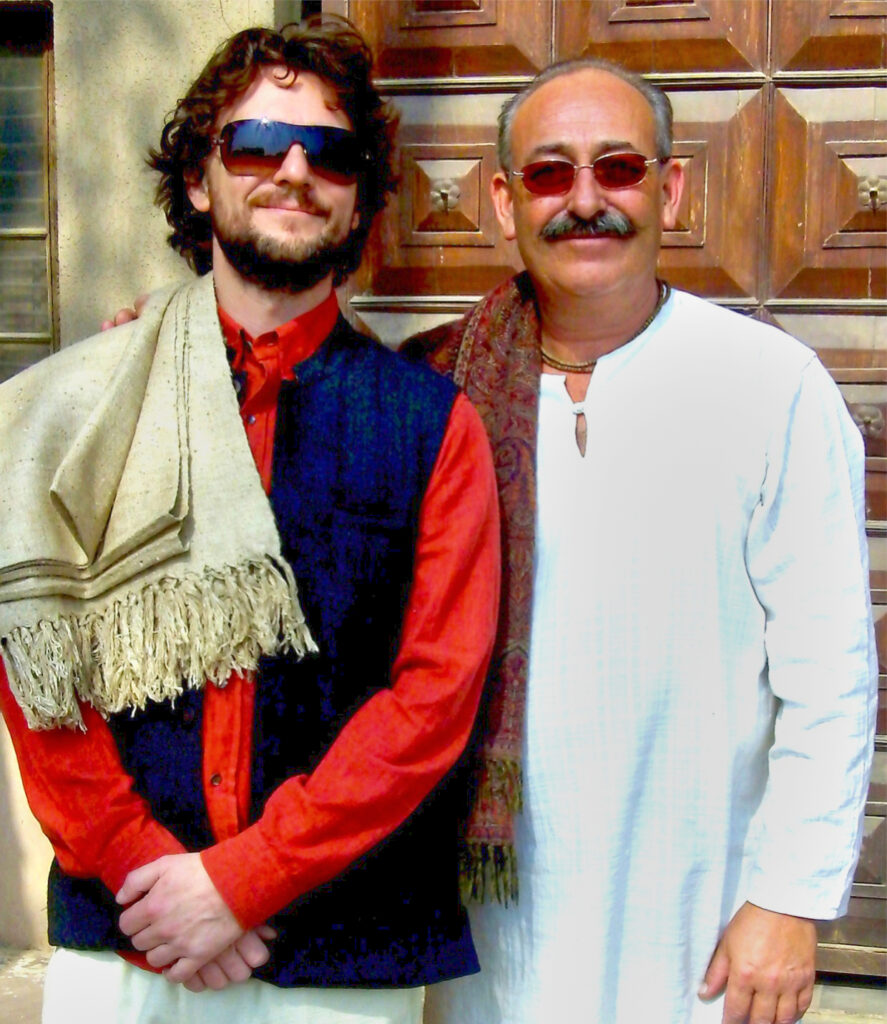
Darren Sangita & Mathura Das
in Vrindavan 2008
THE STYLES AND SOUNDS WITHIN ‘ASHIRVAD’
Sacred sound permeates the entire history of Indian culture. From the ancient Sanskrit hymns and mantras of the Vedas and Upanishads, to Medieval Drupada, Courtly Khyal, Amorous Thumri, Devotional Bhajans, Dhuns and Kirtans. Ashirvad is an attempt to weave together, some of the various elements of sacred sound inherent in the vast spectrum of Indian music in a sympathetic way with modern technological styles. I have spent over thirty years listening to and researching the history and theory behind this amazing culture and can only describe it as a kind of love affair. Darren is coming from a different direction towards the same subject, bringing years of fascination and practical research with sound recording into the co-production dynamic.
Apart from our mutual love of Indian music, we also have affinities with other forms of electronic and world music styles that have mystical, transcendental, spiritual or uplifting elements in the mix, such as Dub Reggie, African, Persian, Middle Eastern, Quawali as well as various old and new electronic Ambient and Chill Out genres. Various sacred music styles from around the World share similarities in their intrinsic make up. The most popular forms of folk trance music, happen in a communal sacred space where the people (folk) can get down and participate while contributing to the group experience. For an upbeat communal trance, the foundation is a hypnotic groove or pulse that can be easily clapped along and danced to. Riding on top of the rhythmic groove lies the melody line, normally lead by a chant, song or incantation that can sometimes be joined in with by the group, tribe, participants or audience. Most music of this type is modal, as it is fixed to a particular unchanging melodic (scale), thus incorporating another important musical ingredient in the structure of communal trance states. Therefore, a hypnotic groove combined with a focused modal melody line and/or a sacred song or chant, is the basis of most popular forms of spiritual music, plus of course the initial spiritual intentions of the musicians, audience or participants that define it’s qualities, sense of focus and intrinsic nature.
Other types of spiritual music are generally more subtle and sophisticated, in the sense that they are specialised and were designed to be performed by master musicians in royal courts, or for gods in temple environments, and are not meant to be participatory, but rather viewed or heard. Though all forms of sacred Indian music share common elements; Religious, Folk, Devotional, Classical or Light Classical, where they differ, is in their style of language and the complexity of their rhythmic and melodic structures.
The constant drone of the 4 or 6 string tanpura instrument, represents OM, the foundation of Indian sacred sound, as well as substantiating the dominant key, and is common to all forms of spiritualised Indian music. This is achieved through an ancient scientific understanding regarding the spiritual relevance of pure intervals (notes) based on the natural harmonic series, called ‘Just Intonation’ or ‘Pythagorean tuning’ by Western musicologists, that is in subtle contrast with the popular form of piano based Western tuning called ‘Equal Temperament’.
The traditional classical 4 string tanpura is played in cyclic repetition, starting with the first string tuned to the 5th, (A pure note (interval) of the middle scale, with out a sharp or flat.) then two high strings of the dominant key, resolving with the bass string also vibrating in the main key. Small cotton threads are strategically placed under the strings on the bridge that create a buzzy sound. When played softly and consistently, a wonderful ambient space is instantly created due to the pure mathematical nature of the relationship between the vibrating notes (The dominant and the 5th), creating what can be called a sonic field of swaras. Swaras are purely intoned notes that when amalgamated in harmonious relationships, create spiritual vibrations that resonate with subtle nadis (meridians) that run through the heart region, creating a sense of rasa (the aeshetic taste of emotional liquid current).
The swaramandala raga harp is an instrument that extrapolates upon the theme of harmonious modal music. The root tanpura drone defines the key, while the swaramandala being tuned to the specific intervals (notes) of the chosen Raga (melodic mode), expands the geometric sonic field, (a mandala). Generally used by classical singers who gently strum the harp on their laps while their students continuously strum two large tanpuras behind them. The beautiful heavenly wash of the swaramandala provides a gorgeous ambient space along with the primal tanpura, as well as being a valuable creative tool, aid and tonal guide for the musicians.
Raga or melody is one leg of the Indian musical matrix, Tala or rhythm being the other. One without the other is incomplete and considered lame music. The most popular forms of rhythm are generally composed of various divisions of 3 or 4 beats, as they are the easiest meters to clap hands, beat drums, express poetry, prayers or sound formulas to. Due to the popular utilization of the 4 beat rhythmic formula throughout all forms of Indian music, we decided to make the album as accessible as possible by using it as a consistent unifying principle and trance element, along with the ambient sounds of the tanpura and swaramandala.
Ashirvad is a series of sonic landscapes inspired by Indian Ragas and various spiritual themes that will take you on a mystical journey to transcendental realms of wonderous splendor. Ravi Shankar once remarked, “A Raga is that which colours the mind”. Raga can also mean natural, spontaneous or intense emotional passion. A Raga is specifically a type of living force in the form of a specific arrangement of musical notes, containing an aesthetic mode of being called Rasa. After years of systematic instruction and practice at the feet of a Guru (master), the mature musician in a spirit of devotional freedom, explores the aesthetic nature of the Raga through intense emotional feelings (Bhava), thus evoking the inherent Rasa contained in the Raga’s specific musical form, and in a sense enters a controlled ritualized musical trance. In such a finely honed focused space, the spirit of the Raga fuses with the musician through a type of empathatic resonance, allowing it to naturally flow through the voice or instrument as an act of sublime grace.
Track 1. KUSH TEA is a journey through exotic spaces, inspired by the devotional sentiments of Raga Bhairavi. The ambient intro opens to auspicious mantras with Sukhdev Mishra glorifying the holy name of ‘Hari’, followed by Gopal Banerjee praising the cosmic gurus of the Vedic pantheon with the famous invocation, “Guru Brahma, Guru Vishnu, Guru Deva Maheshvara, Guru Sakshad Param Bramha, Tasmai Sri Guruve Namah”. Gypsy guitar then introduces a melodic theme from a popular Bengali Bhajan, “Bhaja Hure Mana” by the 16th cent. Vaishnava poet Govinda Das, who advises his mind to be devotional “My dear mind, just take shelter in adoring Sri Nandanandana (Krishna), at whose lotus feet there is no fear”. The journey then takes us through a mystical flight of fancy with dreamy cello, oboe, violin and an ambient incantation. The dynamics then rise with dramatic insistence to a Central Asian Gipsy jig, then turns East again via Varanasi to the grooves of Bengal. Concluding our mystical journey, we find the ecstatic bard Haradhan das Baul, wandering along the banks of mother Ganga, questioning his divinely inebriated state with the poignant finale, “Ki mod kowalo kishori ?” “What intoxicant have you given me?”.
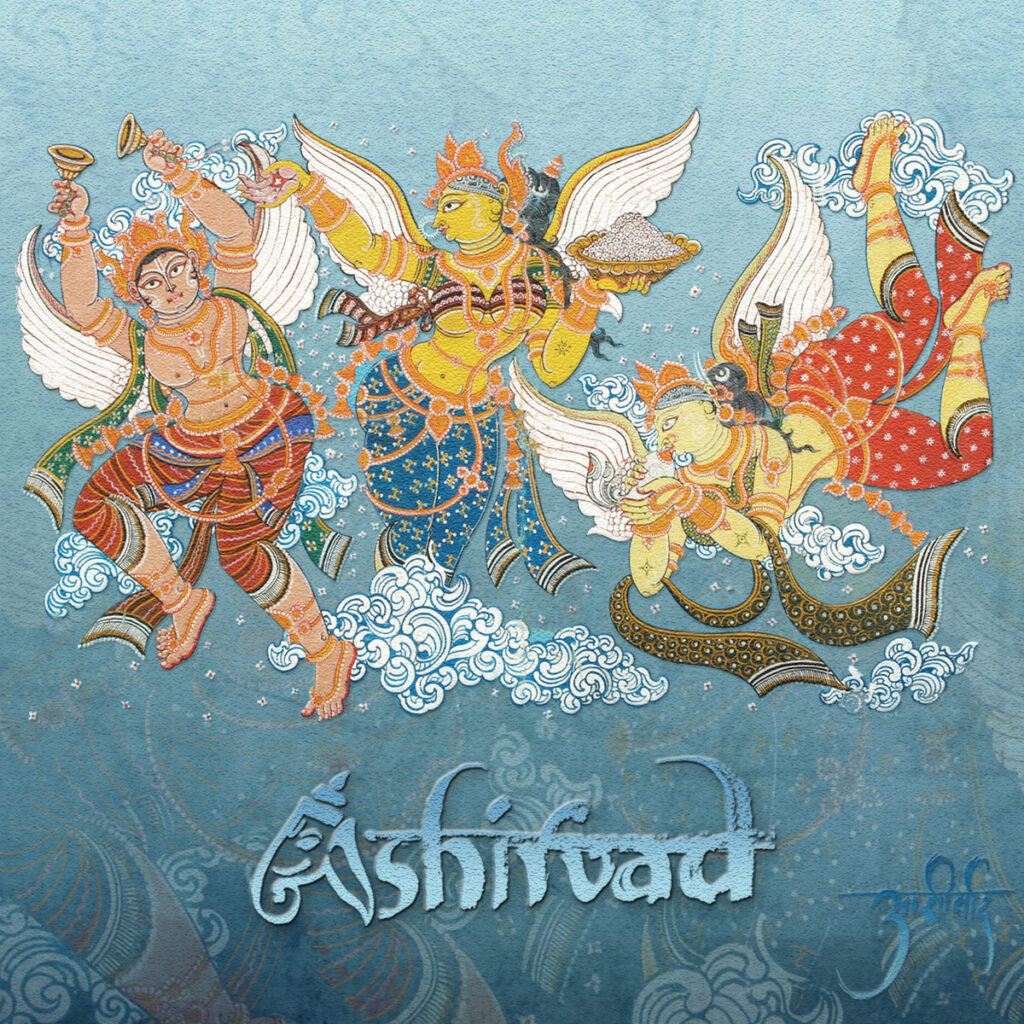
Track 2. GARUDA’S DREAM is the track with the most live feel on Ashirvad, giving it a sense of flying free. (Garuda is the winged, half man/bird carrier of Vishnu). The brilliant violin and vocal overdubs were created by Sukhdev Mishra after recording him also playing tablas live along with Mathura das’s twelve string groove, which was originally conceived during a jam they had together in a friends kitchen in Brixton in 2005. Sukhdev also added the main refrain to the composition and being a veritable one man show, later strummed the swaramandala. The basic guitar composition was quite simple but played in a sequence of open chords in mixolydian mode, allowing Sukhdev to have fun improvising with the flow, by sending it dancing to a mighty crescendo through a wonderfully spontaneous contrast of vocal inflections and dazzling riffs on his violin. Darren pulled the original recording out of the Sangita Studio archives when he returned from India in 2008, and went about polishing and setting the track with level upon level of magic ingredients to enhance the dynamic mood, along with some more guitars and percussion by Mathura das when he finally returned to London two months later.
Track 3. MAGIC CARPET utilizes Raga Bhairagi, a melodic scale containing the notes used in the traditional chanting of Sanskrit mantras such as the Purusha Shukta, Vishnu Sahasra Nama and other sacred texts. The luxurious pulsating groove along with the seductive Bansuri bamboo flute playing of Shyan Kishori, entices us to an encounter with the primordial mystery of an ancient time, as the haunting vocals of Sherin Sengupta guide us on a sacred vision quest to the core of our being.
Track 4. CITY OF JOY is an ode to the unique vibrancy of Kolkata. Cal. as it known by it’s residents and afficianados, has probably more artists, musicians and poets per capita than any other city in the world. It is also the state capital of Bengal, and was once considered the second most influential city in the entire British Empire. Darren wanted to capture the feelings of an unknown gem from the Calcutta underground music scene, and upon meeting Gopal Banerjee realised he had found a perfect example of the unblemished talent he was seeking. Mathura das and Darren somehow managed to coax the shy reluctant Gopal into singing along with an ambient piece Darren had composed earlier in his hotel room. And despite the busy street sounds outside his house and with regular friends in attendance, Gopal manages to completely submerge himself in the moody pathos of a Purvi type Raga alap (intro.). He then proceeds to introduce an amazingly unique example of swimming in the glorious nectar of the famous 32 syllable ‘Hare Krishna’ Maha Mantra (names of God), with the mystical depth and devotion of an ancient Rishi (Sage).
Track 5. THE VISION takes the form of a traditional light classical Thumri composition, enhanced with modern technological sensitivity. Sukhdev Mishra’s beautiful vocals, with a just a few lines of exquisite Hindi poetry, depict a romantic recollection of lover’s eyes meeting passionately as if for the first time. The soulful Sarangi of Dabashish Haldar echoes with masterful ease and refinement that magical moment where magnetic attraction stirs in the hearts of lovers. The watery rhythmic pulse, is the sound of the clay bodied double ended Bengali mridanga drum called ‘Sri khol’, beautifully played by Govind Pandit in Navadwip, a holy town on the Ganges River situated three hours north of Kolkata.Allow yourself to be softly embraced by the mellow sounds of the ‘Vision’, while you drift gently on sacred streams of sonic nectar towards an infinite ocean of celestial blessings.
Track 6. ASHIRVAD continues the gentle flow with a Mirabai bhajan set in the light pastoral mood of a Pahari (mountain) folk melody. Mirabai was a 16th century Rajput Princess, who renounced her royal lifestyle due to her intense loving devotion for Krishna, becoming one of the most famous poet saints of North India. Dr. Ashwin Kalbagh was inspired by a melodic theme we had developed, then lovingly created his own beautiful composition to accompany our theme with her poem, which describes the inseparable relationship Mira has with her unpredictable lover Sri Krishna. Mira finally implores Krishna to allow her to be a resident of Braj, (Krishna’s residential district) where every step is a dance, every word a song and the sound of His divine flute will always be her constant companion.
Track 7. THE VALE OF AVALON is an evocative instrumental piece originally created in Glastonbury, the ancient sacred spiritual center of England in the West country of Somerset. The sparkling sound of Sadhu Seva’s guitar picking along with the swaramandala harp, recalls an ancient Celtic brook, bubbling up from a sacred spring while refreshing the lush apple orchards of this mystical valley steeped in myth and legend. The river of life then flows East to Goa, where Eugene Moriaty from Russia joins us on our journey with his one take wonder sax solo, inspired by Raga Bhairavi and performed in Indian Shenai (Indian oboe) style while riding along the rolling waves of the tabla, thus linking the liquid spiritual pulse and flow of life from West to the East.